How the website scan works
The scan reads your live site and public records, then checks seven things a browser, Google, an AI agent, and email providers all care about. Here is exactly what we check and where the results come from.
What the scan checks
The scan reads your live homepage and public records, then checks seven areas: how bots see your homepage, malware and phishing reputation, email delivery setup, connection security, page speed, the technology you run, and your domain and hosting. Every check is something we can read right now. We report what we find.
Seven checks, every one something you can read and fix
Homepage content for bots
Whether search engines and AI agents see the same homepage a visitor sees.
- We fetch your homepage the way a bot does, then compare the raw text a bot reads against the page a person sees.
- We flag when key content shows up only after JavaScript runs, which some crawlers skip.
- The result tells you whether your words are actually readable by the tools that send you traffic.
Malware and phishing reputation
Whether your domain shows up on the public malware and phishing lists that browsers and email providers check.
- Google Safe Browsing status for your domain.
- A multi-engine malware scan of the site.
- Known phishing flags tied to your domain.
Checked against Google Safe Browsing, multi-engine malware databases, and known phishing feeds. A clean result is the normal, healthy state, not a promise you can never be targeted.
Email delivery setup
Whether your domain is set up so the email you send is trusted, instead of marked as spam or spoofed by someone else.
- Mail servers are published for your domain, so email has somewhere to go.
- SPF says which servers are allowed to send as you.
- DMARC tells inboxes what to do with messages that fail the check, which is what stops spoofing.
Connection and browser trust
Whether a visitor’s browser trusts your site on sight, with no warning screen in the way.
- A valid HTTPS certificate is in place and still current.
- The connection uses an up-to-date, supported protocol.
- The basic browser-trust headers are present.
Page speed
How fast your homepage loads on a phone, measured rather than guessed.
- Load speed on mobile and desktop.
- How quickly the main content appears.
- Whether the layout shifts around while the page loads.
Measured with Google PageSpeed, the same field data Google uses.
What your site is built on
The public technology signals your site gives off, like the platform, framework, and services it runs on.
- We detect the CMS and frameworks from public signals.
- We read server and hosting hints the site sends.
- We show each one with its brand so you can see your stack at a glance. This check is informational.
Domain and hosting
The registration and hosting facts anyone can look up about your domain.
- Registration and age details from public records.
- Hosting location and provider.
- A live snapshot of the page as it is served right now.
We report what your site shows, not what it earns
What we do check
The things on your site and in public records that browsers, Google, AI agents, and email providers actually read: your content, reputation, email setup, connection, speed, tech, and hosting. All of it is checkable, and most of it is fixable.
The scan groups its results by how much each one needs your attention, so the things worth fixing rise to the top. Point it at your own domain and it reads your live site. Updated July 17, 2026.
Find the gaps worth fixing.
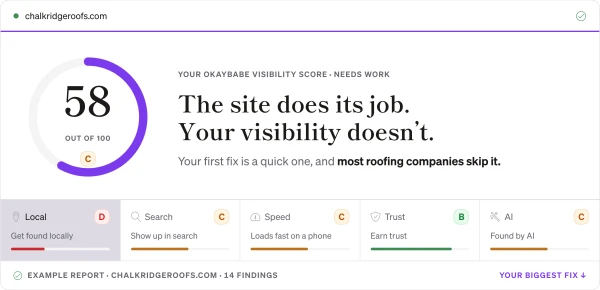
Run the free audit on your own domain. You get the five grades and the specific fixes.